
Why people are asking about Sculptra now
Many patients in Dubai are asking for a face that looks rested and healthy rather than visibly “done”. Alongside Botox and hyaluronic acid fillers, they now ask about treatments that work with the skin over time. Sculptra is one of the names that comes up most often. It sits in a different category from a standard filler, and that difference explains both its appeal and its limits.
What Sculptra is
Sculptra is an injectable made of poly-L-lactic acid (PLLA), a biocompatible, biodegradable material, mixed with water and, in many clinics, lidocaine before use. It is a regulated medical device. In the United States, the FDA approved it for correction of shallow to deep nasolabial fold contour deficiencies and other facial wrinkles in people with healthy immune systems, and in April 2023 added fine lines and wrinkles in the cheek region. An earlier approval covered facial fat loss in people with HIV. Approval in one country does not replace the need to check what is licensed and permitted where you are treated, so always ask your clinic about regulatory status in the UAE.
How it works
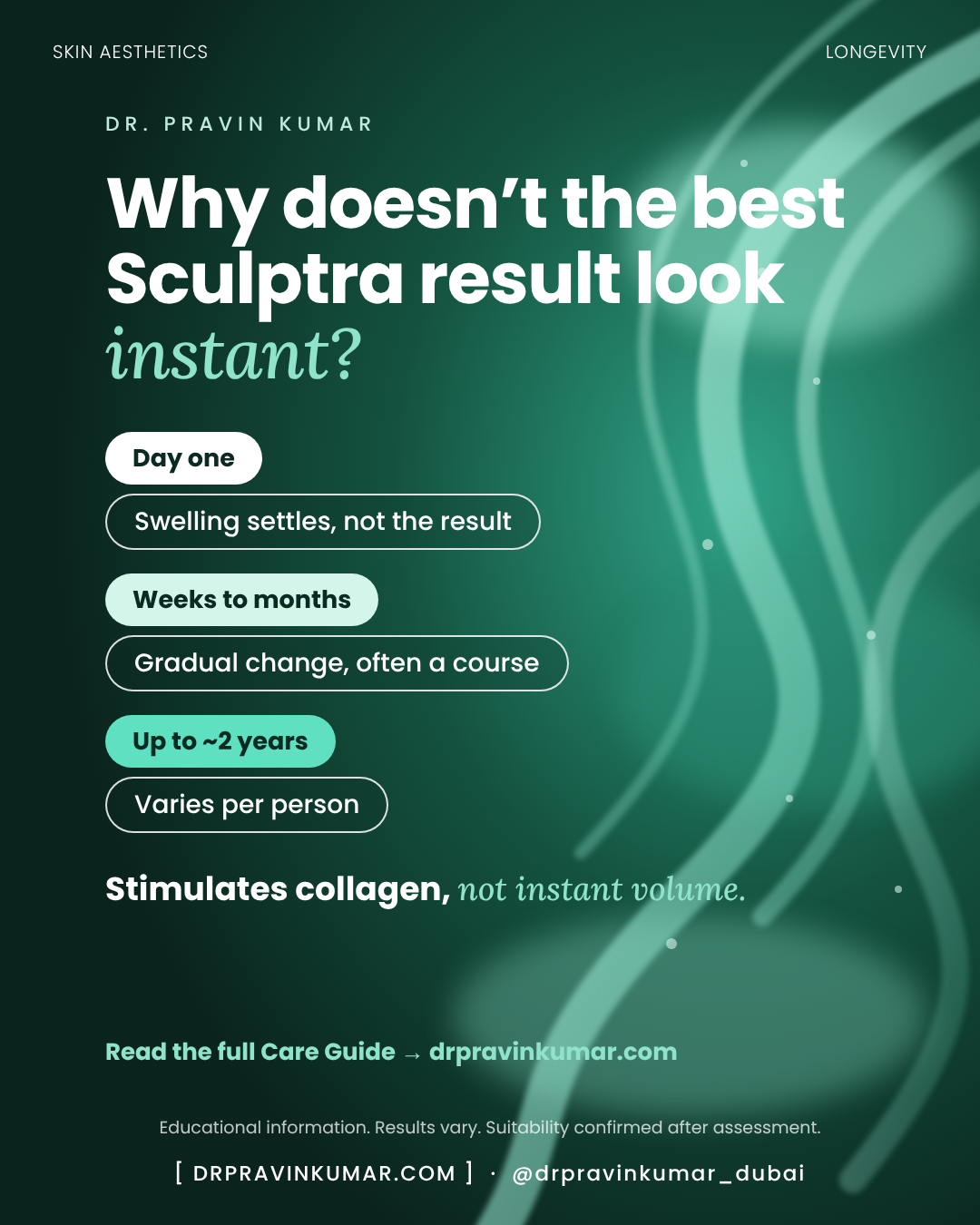
Unlike a hyaluronic acid filler, which mainly adds volume on the day, PLLA is generally described as a collagen stimulator. The injected particles act as a trigger, and the body responds over the following weeks and months. That is why the change builds gradually, and why a good result is not meant to look instant. The final look depends on your own tissue response.
Who may benefit
- Adults with early to moderate loss of facial volume or soft support who prefer gradual change.
- People with fine lines and wrinkles in the cheek area or nasolabial folds, where this has regulatory support.
- Patients who understand that a course of several sessions is usual and are comfortable with a slow timeline.
It is not a facelift, and it will not replace surgery where significant skin excess is the main concern. An in-person assessment decides whether it fits your face, skin and goals.
What the evidence actually says
The FDA review of the cheek-wrinkle indication describes a randomized, evaluator-blinded, no-treatment-controlled study with 149 participants at 13 US sites. At 12 months, 70.7% of the treated group were responders on a blinded evaluator’s cheek wrinkle scale, compared with 25.9% of the untreated control group. Treated participants received a mean of 3.6 sessions in that study. The manufacturer reports that effects can last up to 2 years, and the extension data in the FDA document showed responder rates of 76.9% at month 24 among those followed.
Honest limits matter here. The study population averaged about 60 years of age, was 96.6% female and 90.6% White, and 21.5% had Fitzpatrick skin types IV to VI. That tells us something, but it does not tell us exactly how every patient in Dubai will respond. Responder rates describe groups, not guarantees for you. The control group had no treatment, not a competing filler, so the study does not show Sculptra is better than alternatives. Duration claims come from the manufacturer and the extension cohort, and individual duration varies.
What happens in treatment
After a consultation and facial assessment, the area is cleaned and numbed, usually with topical anaesthetic and lidocaine in the mixture. In the FDA study, a 25-gauge needle was used and the product placed in the deeper tissue layers with several techniques, including linear threading and fanning. A typical session is brief. The labelled regimen allows up to 4 sessions about 4 weeks apart. Many practitioners advise gentle massage of the area afterwards for a period, and your clinician will give specific instructions, which matter for reducing lumps.
Realistic results and timeline
- Immediately after: some swelling from the fluid is common, and it settles within days. This is not the result.
- Weeks to months: change develops gradually, and a course of sessions is typical.
- Around 12 months: this was the time point for the main FDA study endpoint.
- Up to about 2 years: the manufacturer cites this as the possible duration, though it varies from person to person.
Results vary, and a top-up plan is something to discuss at your assessment.
Side effects and safety
In the FDA study, 44.3% of treated participants reported any adverse event versus 5.8% of controls. Treatment-related events were mostly mild or moderate; injection-site bruising was most common (11.3%). Almost everyone reported short-term symptoms such as tenderness, bruising, swelling or pain, and 76.1% resolved within 14 days. One participant developed injection-site nodules that were still present at the end of the study.
The FDA document also lists post-marketing reports of serious but less common problems: papules or nodules that can appear months after treatment (sometimes 1 to 14 months, and occasionally lasting up to 2 years), granuloma or foreign-body reactions, infection or abscess, hypersensitivity, and vascular complications including tissue damage and, rarely, visual disturbances. Vessel injury is an injectable risk in general. This is why training, anatomy knowledge and avoiding high-risk areas matter. The manufacturer advises against injecting the red part of the lips and the area around the eyes.
Who should avoid it
- Anyone allergic to a component of the product, or to lidocaine if it is used.
- People with a history of keloid or hypertrophic scarring.
- Anyone with active skin infection, inflammation, cysts or rashes in the area, until healed.
- People who are pregnant, breastfeeding or under 18, as safety has not been established.
- Those with a weakened immune system, as the approvals apply to immune-competent patients.
Comparison with alternatives
- Hyaluronic acid filler: immediate volume, adjustable, and can be dissolved if needed. Typically shorter-lasting, and does not rely on collagen response.
- Sculptra: gradual, needs a course, and is not easily reversible, so technique and dosing are important.
- Ultherapy and energy devices: aim to tighten lax skin without adding product. They address a different problem.
- Skin boosters and polynucleotides: focus on hydration and skin quality rather than structural volume.
Many plans combine approaches. Which one is right depends on your anatomy and goals, not on what is trending.
Questions to ask before booking
- Is this product genuine, licensed for use in the UAE, and can I see the packaging?
- How many sessions do you expect I will need, and what is the total cost?
- Who performs the injection, and what is their training and experience?
- How do you manage delayed nodules, and what is the plan if a complication occurs?
- What aftercare, including massage, will I need to do?
- What are the alternatives for my concern, including doing nothing?
FAQs
Will I look different straight after?
You may look swollen for a few days, and that is not the final result. Gradual change is the point.
Is it permanent?
No. The manufacturer cites up to about 2 years, and it varies.
Is it painful?
Numbing is used, and tenderness afterwards is common.
Can I go back to work?
In the FDA study, the median time to comfortable social return was about 3.9 hours after the first session and 7.1 hours after the fourth. Your experience may differ.
Can it be dissolved?
Not in the same way as hyaluronic acid filler, which is a reason to choose your injector carefully.
Book a consultation
If you are considering Sculptra or want to compare options for your face, book an assessment with Dr. Pravin Kumar. We will review your goals, your skin and your medical history, and tell you honestly if it is not the right choice.
Book a consultation at drpravinkumar.com
Sources
- U.S. FDA, PMA P030050/S039 summary document for Sculptra (cheek wrinkles supplement)
- Galderma press release, “Galderma receives FDA approval for Sculptra for cheek wrinkles” (April 2023)
The manufacturer press release is promotional material, so it is used only for the manufacturer’s stated claims.
Disclaimer: Educational information only, not medical advice. Results vary. Risks, contraindications and suitability are confirmed after an in-person assessment. Product availability and regulatory status vary by country.