
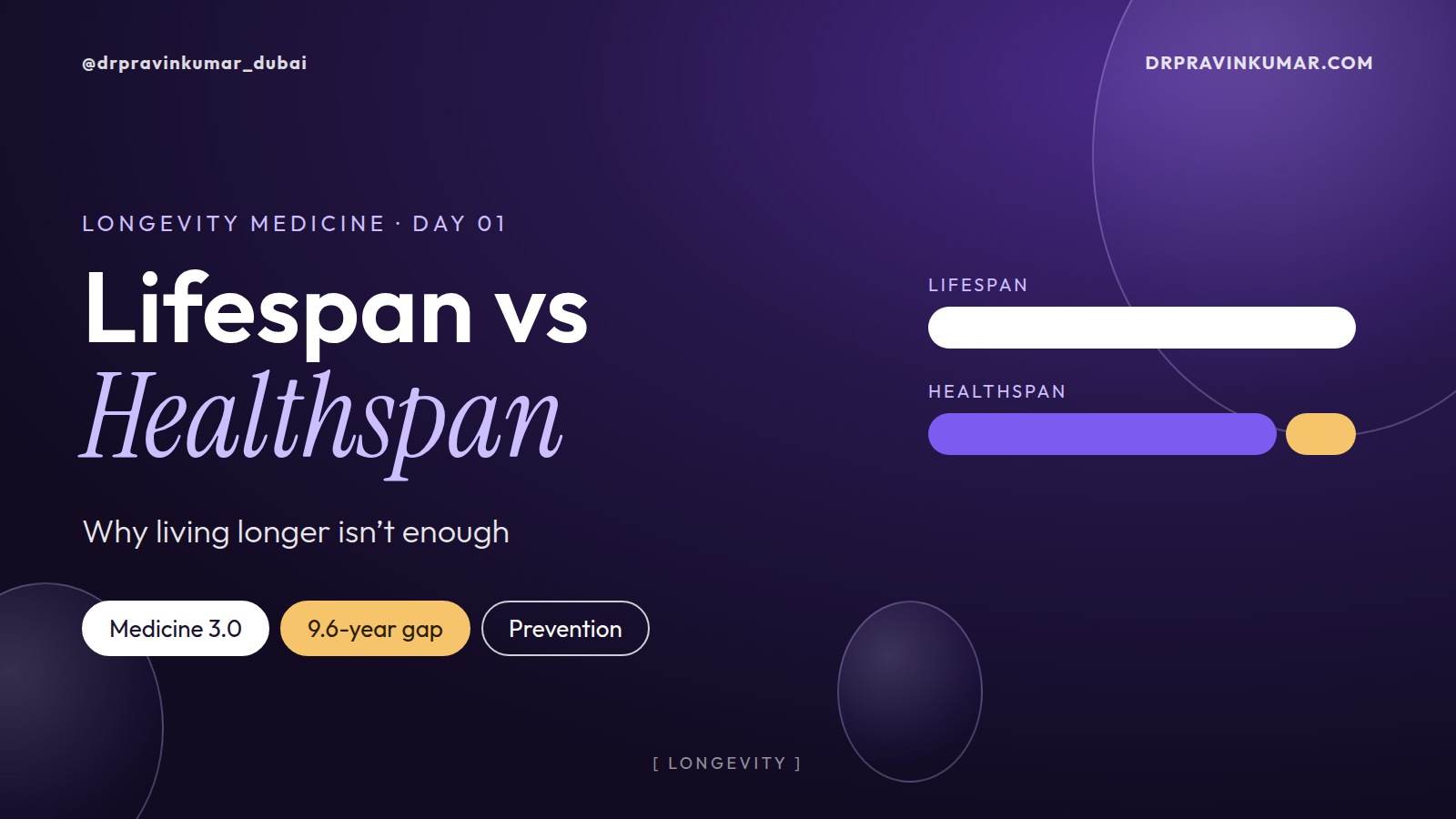
We often celebrate rising life expectancy, and rightly so. Modern medicine has helped people survive infections, injuries and heart attacks that would once have been fatal. But there is an important question behind the headlines: are those extra years healthy ones?
What is lifespan?
Lifespan is simply how long you live, from birth to death. At a population level, it is measured as life expectancy.
What is healthspan?
Healthspan is the number of years you live in good health: free from serious disease and disability, able to move, think clearly and live independently. The World Health Organization measures this as health-adjusted life expectancy (HALE).
The difference between the two is the number of years spent living with illness or disability. This is called the healthspan–lifespan gap.
What the latest research shows
In December 2024, researchers from the Mayo Clinic published a study in JAMA Network Open that analysed data from 183 WHO member states over two decades. Their findings were striking:
- The global healthspan–lifespan gap reached 9.6 years in 2019.
- The gap grew by around 13% between 2000 and 2019.
- Women experienced a gap about 2.4 years wider than men.
- The United States had the largest gap, at 12.4 years.
In other words, we are adding years to life, but not always life to those years.
Why the gap is growing
Most healthcare today is designed to respond once disease appears. This approach works brilliantly for sudden problems such as infections and injuries. But the conditions that take away most healthy years develop slowly, often over decades, without symptoms.
Four conditions account for much of this loss:
- Cardiovascular disease, including heart attack and stroke
- Cancer
- Neurodegenerative disease, such as Alzheimer’s and other dementias
- Metabolic disease, including insulin resistance, type 2 diabetes and fatty liver
Metabolic health is especially important because poor metabolic health increases the risk of the other three.
A different approach: longevity medicine
Longevity medicine, sometimes called Medicine 3.0, focuses on finding and reducing risk years before disease develops. It is built on three ideas:
- Prevention first: acting early rather than waiting for a diagnosis.
- Personalisation: using your family history, blood markers, fitness level and personal goals.
- Honest evidence: separating what is proven from what is still experimental.
The most powerful tools are often the most familiar: regular exercise that builds both fitness and strength, good nutrition, quality sleep, emotional wellbeing and strong relationships. When needed, medicines can be used earlier and more precisely.
Think about your “last decade”
A useful question to ask yourself is: what would I like to be able to do in the last ten years of my life? Perhaps it is climbing stairs comfortably, travelling independently or playing on the floor with grandchildren.
Strength, fitness and balance naturally decline with age, so maintaining them later in life depends on building them now.
Simple steps you can take today
- Know your blood pressure and waist measurement.
- Ask your doctor about a more complete cholesterol assessment, including ApoB and a one-time Lipoprotein(a) test.
- Check your blood sugar control with an HbA1c test.
- Build regular movement into your week, including both aerobic exercise and strength training.
- Prioritise sleep and stay socially connected.
The bottom line
The goal of longevity medicine is not simply to live longer. It is to stay strong, independent and mentally sharp for as many years as possible.
If you would like to understand your own health risks and create a personalised prevention plan, book a consultation with Dr Pravin Kumar.
This article is for general education and does not replace personal medical advice.
Reference: Garmany A, Terzic A. Global Healthspan-Lifespan Gaps Among 183 World Health Organization Member States. JAMA Network Open. 2024;7(12):e2450241.