
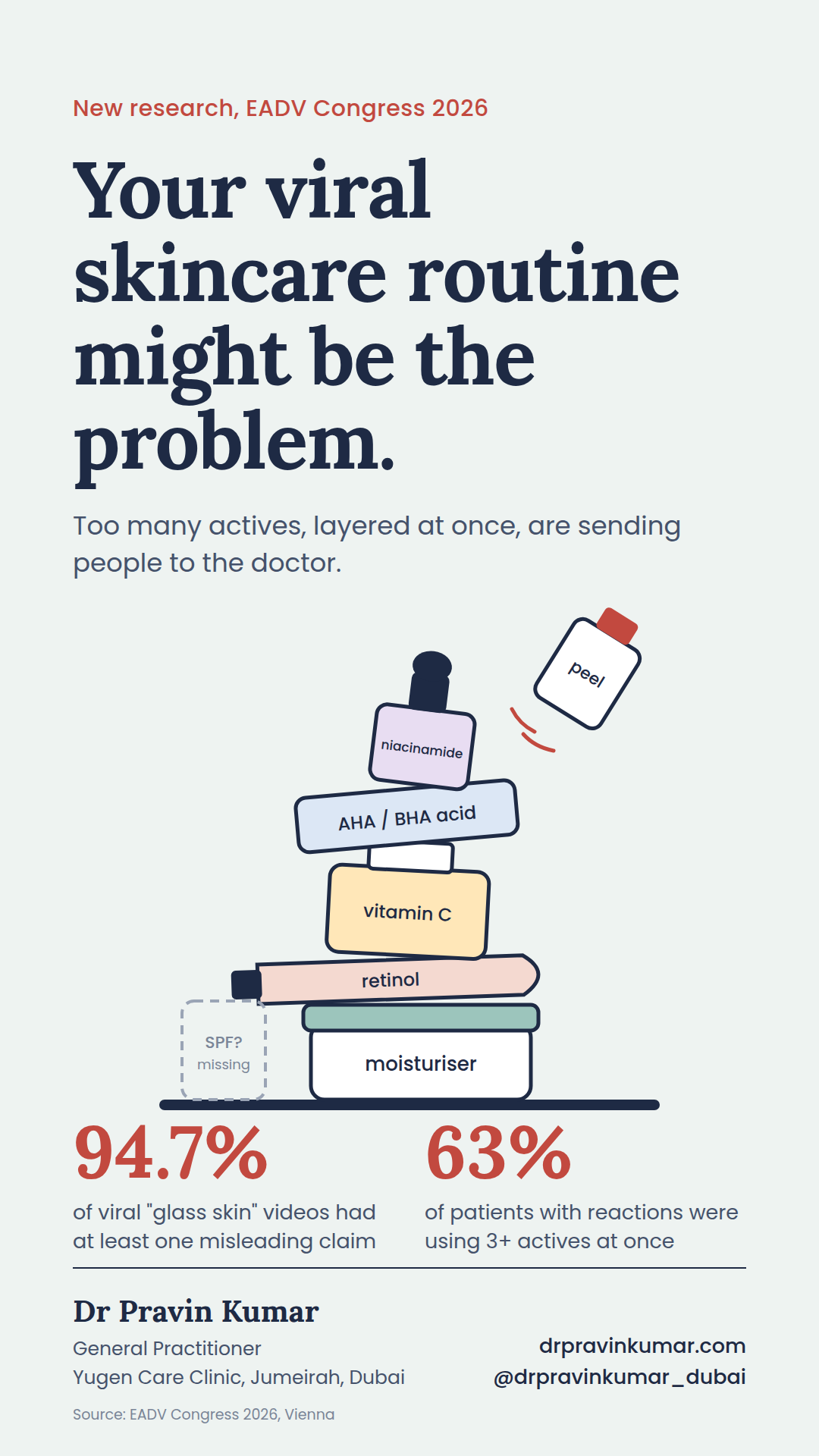
Viral skincare looks harmless. The data says otherwise.
Scroll for two minutes and you will see it: a ten-step "glass skin" routine, a toner, three serums, an acid, a retinol, all layered in one night. It looks calm and clean. But new research presented at the European Academy of Dermatology and Venereology (EADV) Congress 2026 in Vienna shows that copying these routines is sending real people to dermatology clinics.
In my GP practice at Yugen Care Clinic in Jumeirah, I see this pattern often. Patients arrive with red, stinging, breaking-out skin, and a bathroom shelf full of products they bought because a video said so.
Study 1: almost every viral "glass skin" video was misleading
Researchers searched TikTok in May 2026 using a fresh account, so the algorithm could not skew results. They analysed 38 top-performing Korean skincare and glass-skin videos. What they found:
- 94.7% contained at least one potentially misleading claim
- 84% ignored differences in skin type
- 45% encouraged combining too many active ingredients without safety guidance
- 32% promised instant results
- Only 1 video mentioned irritation risk, and only 2 mentioned sun protection
- None were made by dermatologists, and none cited a single source
The researchers were clear on one point: Korean skincare itself is not the problem. The problem is how good principles, like gentle cleansing, hydration and barrier care, get turned into product-heavy, one-size-fits-all routines.
Study 2: what happened to the people who followed them
A separate study looked at 94 patients who developed a new or worsening skin condition after using products promoted on social media.
- 48% had copied a complete routine straight from social media
- 63% were using more than three active ingredients at the same time
The products most often involved:
Chemical exfoliants (AHA/BHA acids) - 34%
Over-the-counter retinoids - 27%
Vitamin C serums - 14%
Niacinamide products - 11%
And the problems they caused:
Irritant contact dermatitis (red, burning, peeling skin) - 42%
New acne or major acne flare- 28%
Rosacea flare or rosacea-like rash - 12%
Dark marks after inflammation (post-inflammatory hyperpigmentation) - 11%
Superficial chemical burns - 7%
Notice something? These are not dangerous ingredients. Acids, retinoids, vitamin C and niacinamide all have good evidence behind them. The harm came from how they were used: too many, too often, all at once, on the wrong skin type.
A fair note on the evidence: these are conference presentations, not yet full peer-reviewed papers, and the patient study looked only at people who already had a reaction. It does not mean every viral routine will damage your skin. It does show the risk is real.
Why this matters even more in Dubai
Our climate makes skin less forgiving. The UV index here stays high almost all year, and acids and retinoids make skin more sun-sensitive. Long hours in air-conditioning dry the skin barrier out, then heat and humidity outdoors push it the other way. A barrier already under stress from five actives breaks down faster here than in a mild climate.
This is also why the missing sunscreen advice in those videos worries me most. In the UAE, sunscreen is not a step you can skip.
A simpler routine that actually works
For most healthy adult skin, this is enough:
- Morning: gentle cleanser, moisturiser, broad-spectrum SPF 30 or higher, reapplied when outdoors
- Night: gentle cleanser, then one active ingredient if you need it, then moisturiser
- Add new products one at a time, and give each one two to four weeks before judging it
- Don't stack acids and retinoids on the same night unless a doctor has advised it
- Patch test first on a small area, such as behind the ear or on the inner arm
Signs your routine is hurting your skin
Stop new products and get your skin checked if you notice:
- Burning or stinging that lasts after you rinse a product off
- Peeling, raw or shiny-tight skin
- Sudden breakouts after starting something new
- New redness on the cheeks and nose
- Dark patches appearing where you had a rash or spots
Most of these settle once the skin barrier is allowed to recover, but some need treatment, and the earlier the better.
The bottom line
Social media is a great place to get inspired. It is not a place to get a diagnosis or a prescription. Your skin type, medical history and medications all matter, and no video knows them.