
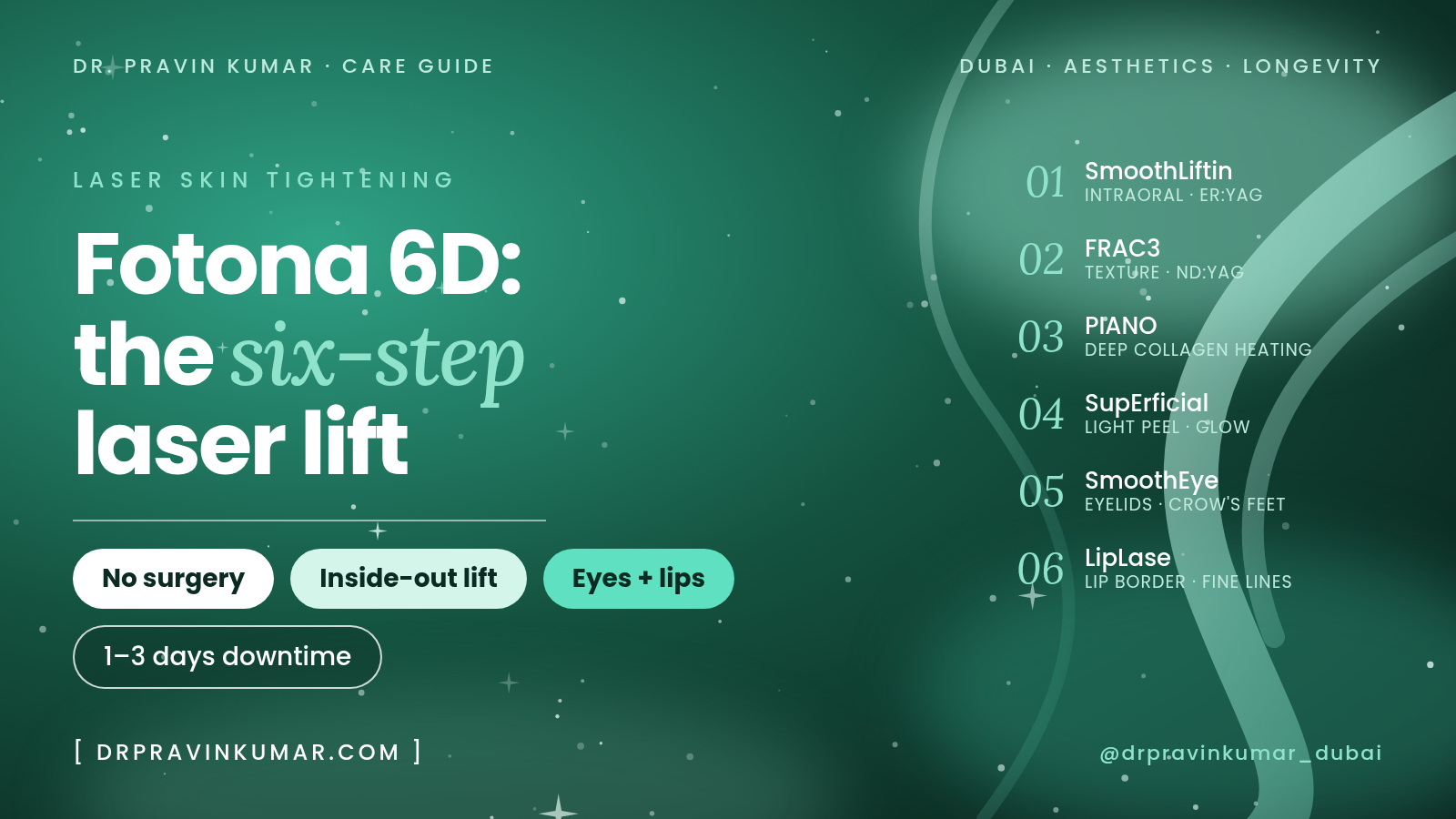
Most people who ask about laser skin tightening in Dubai want the same three things: a natural result, no surgery, and a short recovery that fits around work and social life. Fotona 6D is one of the treatments designed around exactly that brief. It is a non-surgical laser protocol that works on the face from the inside of the mouth outwards, then adds targeted work around the eyes and lips, the two areas where ageing shows first.
This guide is written for patients, not for marketing. It covers how the treatment works, who it helps, who should avoid it, what can go wrong, and how to prepare so you get the most out of each session.
What is Fotona 6D?
Fotona is a Slovenian laser manufacturer. Its SP Dynamis platform combines two laser wavelengths in one machine:
- Er:YAG (2940 nm) — strongly absorbed by water, so it works at the surface and in the upper skin layers. In its special “SMOOTH” mode it delivers gentle heat without removing skin.
- Nd:YAG (1064 nm) — penetrates deeper, warming the dermis where collagen lives.
Fotona 4D is the manufacturer’s four-step full-face protocol using these two lasers. Fotona 6D is a clinic protocol that keeps those four steps and adds two more, most commonly a dedicated periorbital (eye) step and a lip step. The exact combination can vary between clinics, so always ask which six steps your clinic performs. The one described here is the most widely used configuration.
How it works: the six steps
Step 1 – SmoothLiftin (intraoral). The Er:YAG laser is applied inside the mouth, along the inner cheek and lips. Gentle heating of the oral mucosa tightens tissue from within, which is why nasolabial folds and marionette lines often soften first.
Step 2 – FRAC3. The Nd:YAG laser in fractional mode targets small imperfections in the skin: uneven texture, fine lines and early pigment. Energy is delivered to tiny columns of tissue, leaving surrounding skin untouched for faster healing.
Step 3 – PIANO. A longer Nd:YAG pulse warms the deeper dermis in a controlled, even way. This is the “bulk heating” step that stimulates collagen remodelling and gives the tightening effect over the following months.
Step 4 – SupErficial. A very light Er:YAG peel removes only the uppermost dead cells, improving glow and smoothness with minimal downtime.
Step 5 – SmoothEye. The Er:YAG SMOOTH mode is used on the eyelids and crow’s feet area with protective eye shields in place. It helps tighten loose eyelid skin and soften under-eye lines, an area most full-face lasers avoid.
Step 6 – LipLase. The lips are treated from inside and outside to stimulate collagen in the lip border, improving definition and softening vertical lip lines without filler.
Mechanism of action, in plain language
Laser energy is converted to heat in the skin. Controlled heat does two things:
- Immediate collagen contraction. Existing collagen fibres shorten slightly when warmed to the right temperature, which is why skin can look a little firmer straight after the session.
- Delayed collagen production. The mild thermal injury triggers a wound-healing response. Over 8 to 16 weeks, fibroblasts lay down new collagen and elastin, and the skin gradually thickens and tightens.
Because the first step heats from inside the mouth and the later steps work from the surface, the treatment reaches the skin from both directions. This is the real reason it is sometimes described as an “inside-out” lift.
Benefits patients can reasonably expect
- Gradual tightening of the jawline, cheeks and nasolabial area
- Softer fine lines and smoother texture
- Brighter, more even skin tone
- Mild eyelid tightening and softer crow’s feet (Step 5)
- Better lip definition and fewer vertical lip lines (Step 6)
- No needles, no incisions, no general anaesthesia
- Usually back to normal activities within one to three days
Fotona 6D is best suited to mild to moderate laxity. It does not replace a surgical facelift for advanced sagging, and it does not add volume the way fillers do.
Who is a good candidate?
- Adults, typically from the mid-30s onwards, with early to moderate skin laxity
- People who want improvement without surgery or injectables
- Patients who can commit to a series of sessions and daily sunscreen
- All skin types, with parameters adjusted carefully for darker skin tones (common in the UAE) to reduce the risk of pigment changes
Who should not have it, or should wait?
- Pregnancy or breastfeeding
- Isotretinoin (Roaccutane) use within the last 6 months
- Active skin infection, cold sores, acne flare or eczema in the treatment area
- Recent sun exposure or tanning without protection in the previous 2 to 4 weeks
- Photosensitising medications or certain herbal supplements (your doctor will review your list)
- History of keloid scarring, uncontrolled diabetes, bleeding disorders or seizure disorders triggered by light
- Unrealistic expectations of a surgical-level result
Side effects: the honest list
Most side effects are mild and short-lived:
- Redness and warmth for a few hours to 2 days, similar to a mild sunburn
- Mild swelling, especially around the eyes after Step 5, usually settling in 1 to 3 days
- Dryness or light flaking from the superficial peel for 2 to 5 days
- Tenderness inside the mouth for a day or two after the intraoral step
- Temporary lip swelling after Step 6
Less common but important to know:
- Post-inflammatory hyperpigmentation (darkening of the skin), more likely in darker skin types or after sun exposure. This is why pre-treatment sun avoidance and correct settings matter.
- Cold sore reactivation in people with a history of herpes simplex. Preventive antiviral tablets can be prescribed.
- Blistering or small burns are rare and usually related to incorrect settings or treating tanned skin.
- Eye-related effects are prevented by mandatory corneal shields during SmoothEye.
If anything unusual appears after treatment, contact the clinic rather than self-treating.
How to prepare before your treatment
Two to four weeks before
- Avoid sunbathing, tanning beds and self-tanner on the face
- Wear broad-spectrum SPF 50 daily
- Tell your doctor about all medicines, supplements and previous aesthetic treatments
One week before
- Stop retinoids (tretinoin, retinol), glycolic or salicylic acid products and scrubs
- Avoid other facial lasers, peels or microneedling in the same area
- If you get cold sores, ask about starting an antiviral the day before
The day of treatment
- Arrive with a clean face: no makeup, moisturiser or sunscreen
- Brush your teeth and rinse your mouth, as Step 1 is intraoral
- Eat normally; the treatment is comfortable for most people without sedation
- Remove contact lenses before the eye step
What happens during the session
- Photographs and a final skin check
- Cleansing of the face and, for the eye and lip steps, a numbing cream for 20 to 40 minutes
- Protective eyewear for you, with corneal shields placed before SmoothEye
- The six steps in sequence; the full protocol takes roughly 60 to 90 minutes
- A cooling gel or soothing balm at the end
Most patients describe the sensation as warmth with occasional brief pinpricks. The intraoral step feels like a warm spoon inside the cheek.
After the treatment: what to expect week by week
- Day 0 to 2: Redness, warmth, mild swelling. Use a gentle cleanser, a bland moisturiser and SPF 50. Sleep slightly elevated to reduce eye swelling. Makeup can usually be applied after 24 hours.
- Day 3 to 7: Light flaking from the peel step. Do not pick or exfoliate. Skin already looks brighter.
- Week 2 to 4: Early tightening becomes noticeable. Resume retinoids only when the doctor confirms.
- Month 2 to 4: New collagen builds; this is when the lifting effect is most visible.
- Month 6: Peak result for a single session. Improvement continues slowly with each session in the series.
Aftercare rules for the first week: no sauna, steam, hot yoga or intense exercise for 48 hours; no swimming pools for 3 to 5 days; no direct sun; no acids, scrubs or retinoids until cleared.
How many sessions, and how long do results last?
A typical plan is 3 to 4 sessions spaced 4 to 6 weeks apart, followed by a maintenance session every 6 to 12 months. Collagen produced by the treatment is your own tissue, so results fade gradually with normal ageing rather than disappearing suddenly. Smoking, poor sleep and sun exposure shorten the benefit; good skincare extends it.
Fotona 6D compared with other options
- Versus Fotona 4D: 6D adds the eye and lip steps. If your main concern is the lower face only, 4D may be enough.
- Versus Ultherapy / HIFU: these target the deeper SMAS layer with ultrasound and suit deeper sagging; Fotona works on skin quality and surface laxity. The two are often combined at different visits.
- Versus fillers or Botox: these are different tools. Fotona tightens and improves texture; it does not restore lost volume or relax muscles. Many patients use them together for a balanced plan.
Frequently asked questions
Does it hurt?
Most people rate it as mildly uncomfortable at most. Numbing cream is used for the eye and lip steps.
Is it safe for darker skin?
Yes, when settings are adjusted for skin type and the skin is not tanned. The risk of pigment change is lowered further with strict sun avoidance before and after.
Can I go back to work the same day?
Usually yes, though you will be pink. Many patients schedule it before a weekend.
Will I see results immediately?
You will notice glow and slight tightness within days. The lift builds over two to four months.
Is Fotona 6D approved?
The Fotona SP Dynamis laser platform is FDA-cleared and CE-marked for a range of dermatological indications. “6D” refers to the clinic protocol built on it, not a separate device.
Can it be combined with other treatments?
Yes. Common pairings include skin boosters, PRP, Ultherapy for deeper laxity, or a light filler for volume. Sequencing is decided at consultation.
What if I have had filler or Botox recently?
Tell your doctor. Laser is generally performed at least two weeks after injectables, and the intraoral step is adjusted around any lip filler.
How is it different from a surgical facelift?
A facelift repositions deeper tissue and removes excess skin; results are more dramatic and longer lasting, with weeks of recovery. Fotona 6D is a maintenance and prevention treatment with a day or two of downtime.
The bottom line
Fotona 6D is a thoughtful, well-tolerated way to tighten, smooth and brighten the face without surgery, with the added advantage of treating the eyes and lips in the same session. It rewards realistic expectations, proper preparation and consistent sun protection. If you are considering it, book a consultation, bring your questions and your skincare list, and let the assessment decide whether 4D, 6D or a combination plan is right for your skin.
Educational information only. Individual results vary. Suitability is confirmed after a medical assessment at Yugen Care Clinic, Dubai.